10 Amazing Bookshelf Drawing Ideas to Inspire Your Art

Listen, we need to talk about bookshelves. Not just any bookshelves, but the kind you sketch when you’re daydreaming about your perfect reading nook.
You know what I mean – those designs that make you go “Oh, I need to draw that!” I’ve filled countless sketchbooks with bookshelf designs, and honestly? Some turned out amazing, others looked like drunk Jenga towers. But that’s the fun part!
Drawing bookshelves combines two of my favorite things: books and art. The best part is you don’t need to be Michelangelo to create something stunning.
You just need some inspiration, a pencil, and maybe a ruler if you’re feeling fancy. Today, I’m sharing my top 10 bookshelf drawing ideas that range from simple minimalist designs to complex architectural wonders.
Minimalist Floating Bookshelf
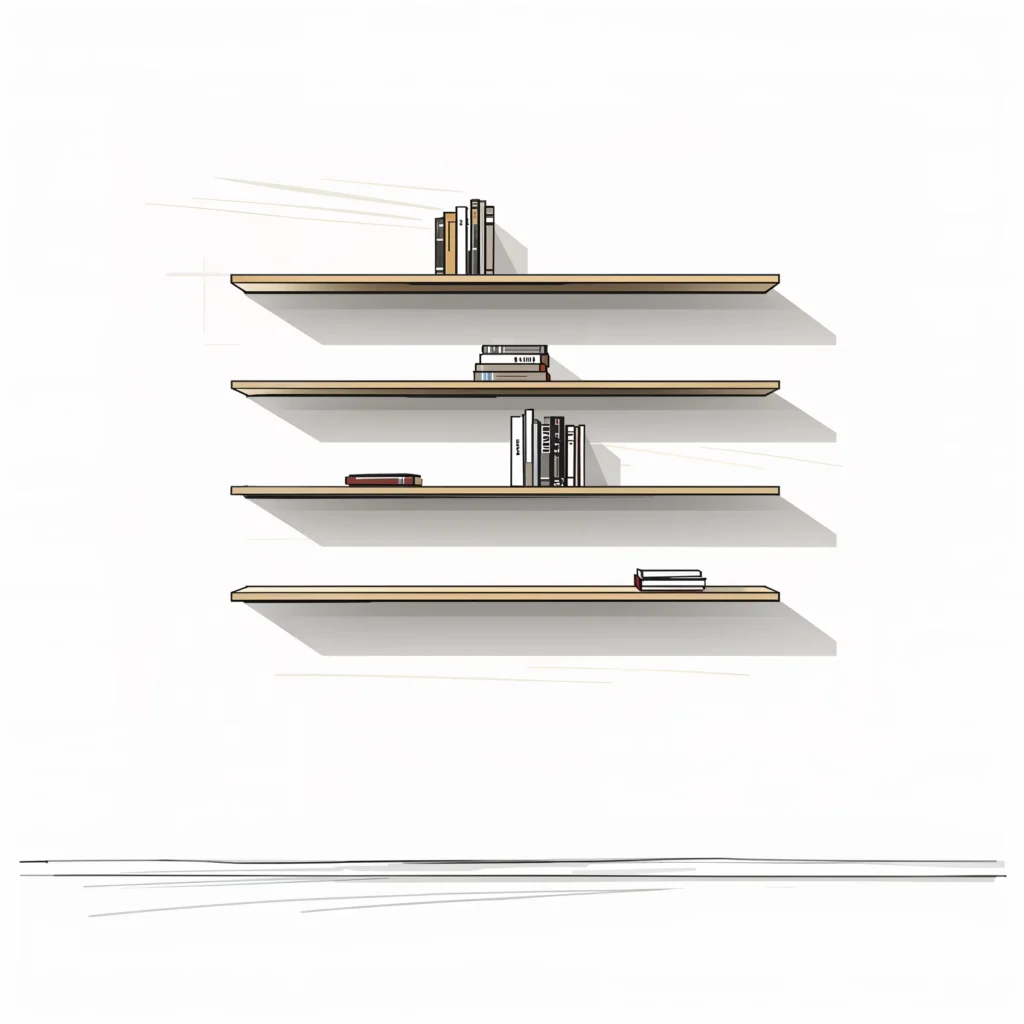
Let’s start with something that looks way harder to draw than it actually is. The minimalist floating bookshelf is basically visual magic – books appear to float on your wall with no visible support. When I first tried drawing this, I thought I’d need some advanced perspective skills. Nope! Turns out it’s all about those clean, simple lines.
The trick here? Start with basic rectangles. Draw your books first, then add subtle shadows underneath to create that floating effect. I like to keep the lines super crisp and clean. No wonky edges allowed! The beauty of minimalist design is that every line matters, so take your time with this one.
Want to make it more interesting? Try drawing the books at different angles. Maybe one’s slightly tilted, another’s perfectly straight. This creates visual interest without cluttering your design. I usually add just a hint of shading where the books meet the “invisible” shelf bracket. It sells the illusion perfectly.
Adding Depth to Your Minimalist Design
Here’s where things get fun. You can play with perspective by:
- Drawing books of varying thicknesses
- Creating subtle gradients on the book spines
- Adding tiny details like bookmark ribbons
- Including shadows that suggest natural lighting
Remember, minimalist doesn’t mean boring. It means every detail you include needs to earn its place in the drawing.
Tree-Shaped Bookshelf
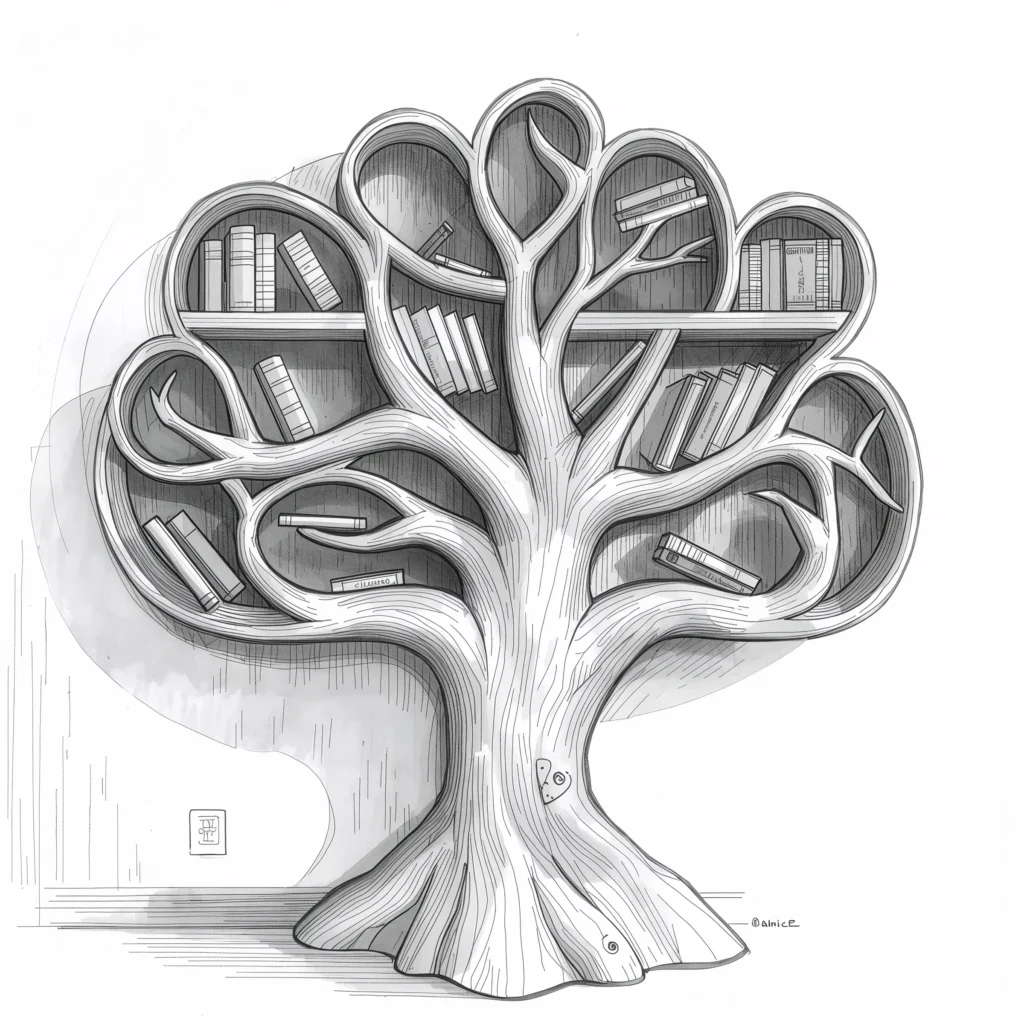
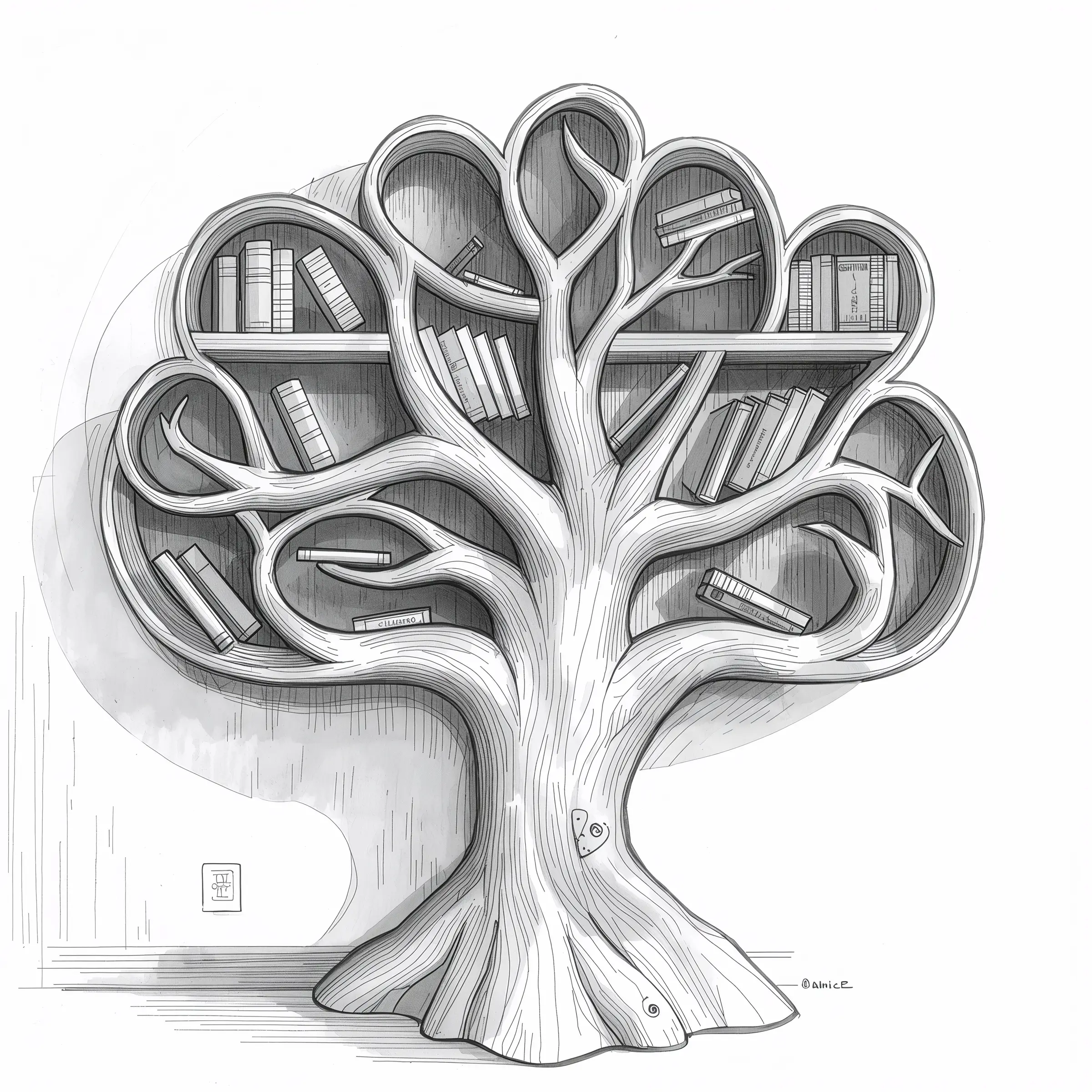
Now we’re talking! The tree-shaped bookshelf is where creativity meets functionality in the most delightful way. I discovered this design while scrolling through Pinterest at 2 AM (don’t judge), and I immediately grabbed my sketchbook.
Start with the trunk – make it thick and sturdy-looking. You’re supporting knowledge here, not just leaves! Branch out (pun totally intended) with varying shelf sizes. Some branches can be short and hold just a few books, while others stretch wide to accommodate your imaginary collection of first editions.
The cool thing about drawing tree shelves? You can make each one completely unique. Maybe yours has gnarly, twisted branches. Or perhaps it’s more geometric, with clean angular “branches” that still somehow read as organic. I’ve drawn probably 20 variations, and my favorite has little reading nooks carved into the trunk. Because why not?
Branch Placement Tips
When sketching your tree bookshelf:
- Make branches thicker near the trunk
- Vary the spacing between branches
- Consider weight distribution (even in drawings!)
- Add small details like wood grain or bark texture
Corner Ladder Bookshelf
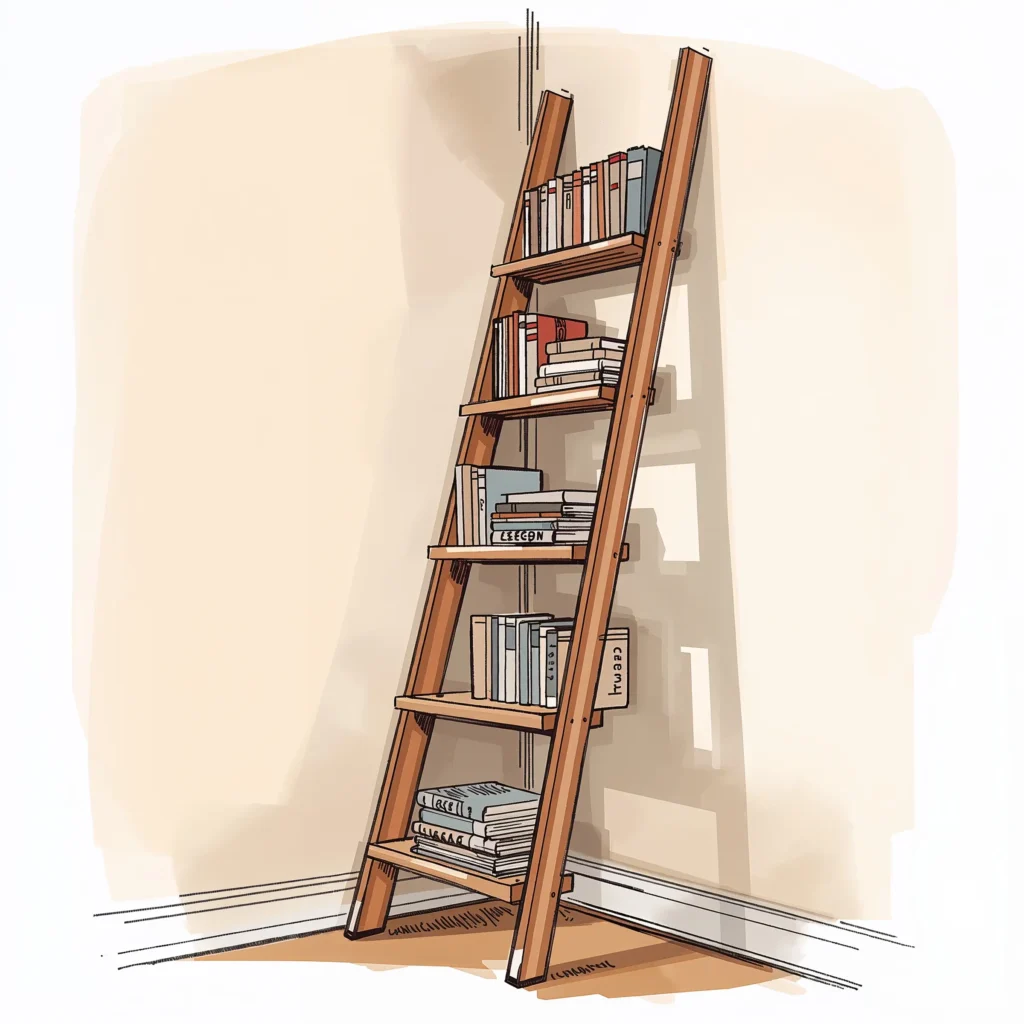
Ever looked at an empty corner and thought, “What a waste of space”? The corner ladder bookshelf solves that problem beautifully. Drawing this baby requires understanding angles, but don’t panic – it’s easier than you think.
I start by drawing two walls meeting at a corner. Then I sketch the ladder frame leaning into that corner at about a 75-degree angle. The shelves gradually decrease in depth as they go up, creating that classic ladder look. It’s satisfying to draw because the geometry just makes sense, you know?
Pro tip: Add books of different heights on each shelf. It breaks up the rigid ladder structure and makes your drawing more dynamic. I learned this the hard way after drawing five identical shelves with identical books. Looked like a prison library. Not the vibe we’re going for!
Making It Look Realistic
To nail the corner ladder look:
- Show the corner seam clearly
- Add subtle wall shadows
- Include support brackets or rails
- Draw books leaning against the back walls
Also Read: 10 Beautiful IKEA Bookshelf Ideas to Inspire Your Home
Modern Geometric Shelf
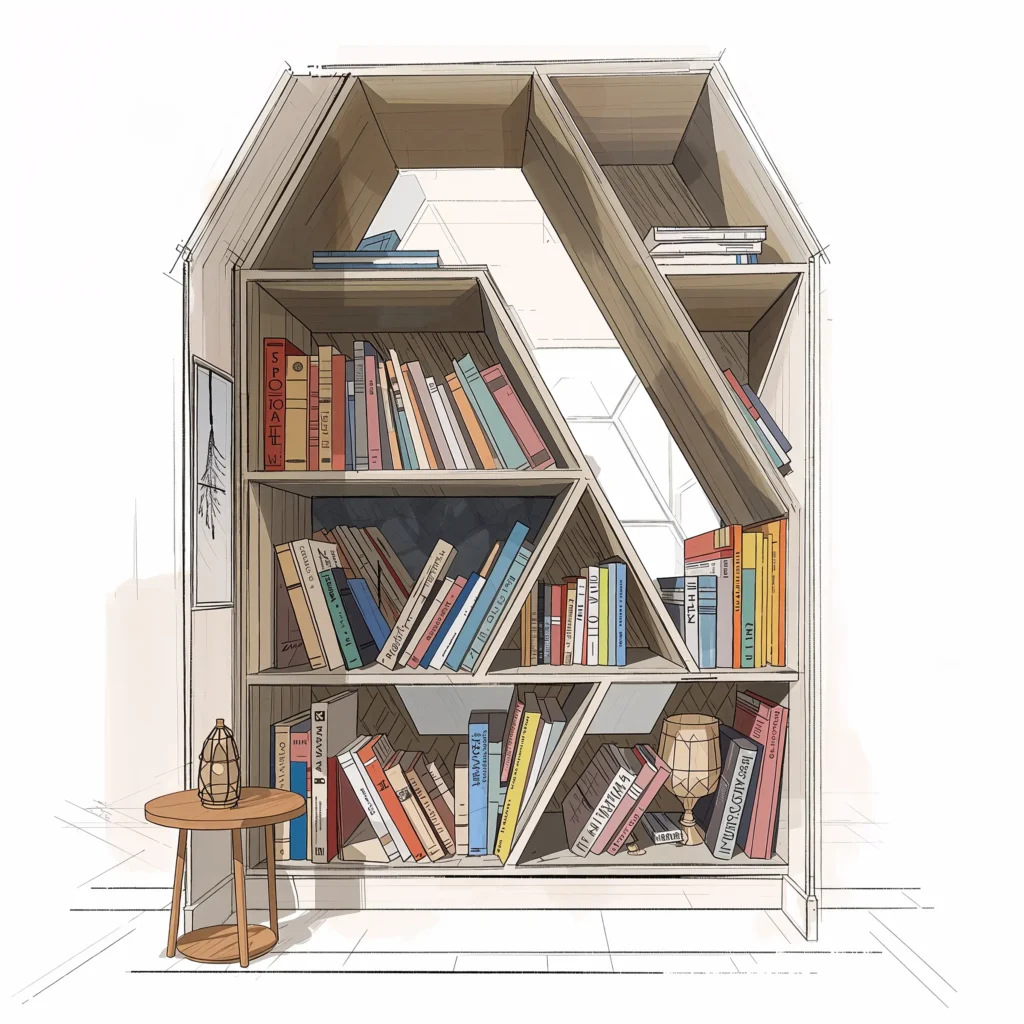
This is where math meets art, and surprisingly, they get along great! Modern geometric shelves are all about unexpected angles and asymmetrical balance. Think hexagons, triangles, and trapezoids having a party on your wall.
I usually start with a large shape – maybe a hexagon – then divide it internally with straight lines. No two compartments should be the same size. That’s the whole point! The challenge is making it look intentional rather than like you sneezed while holding a ruler.
What makes these drawings pop? Bold, confident lines and strategic shading. I add depth by shading one side of each compartment consistently, as if light’s hitting from the same direction. Throw in some books, a small plant, maybe a decorative object, and boom – you’ve got a modern masterpiece.
Geometric Patterns That Work
Some winning combinations:
- Honeycomb patterns (hexagons everywhere!)
- Mondrian-inspired rectangles
- Interlocking triangles
- Mixed shapes that somehow balance out
FYI, if your first attempt looks wonky, join the club. My initial geometric shelf drawing looked like abstract art gone wrong :/
Circular Wall Bookshelf
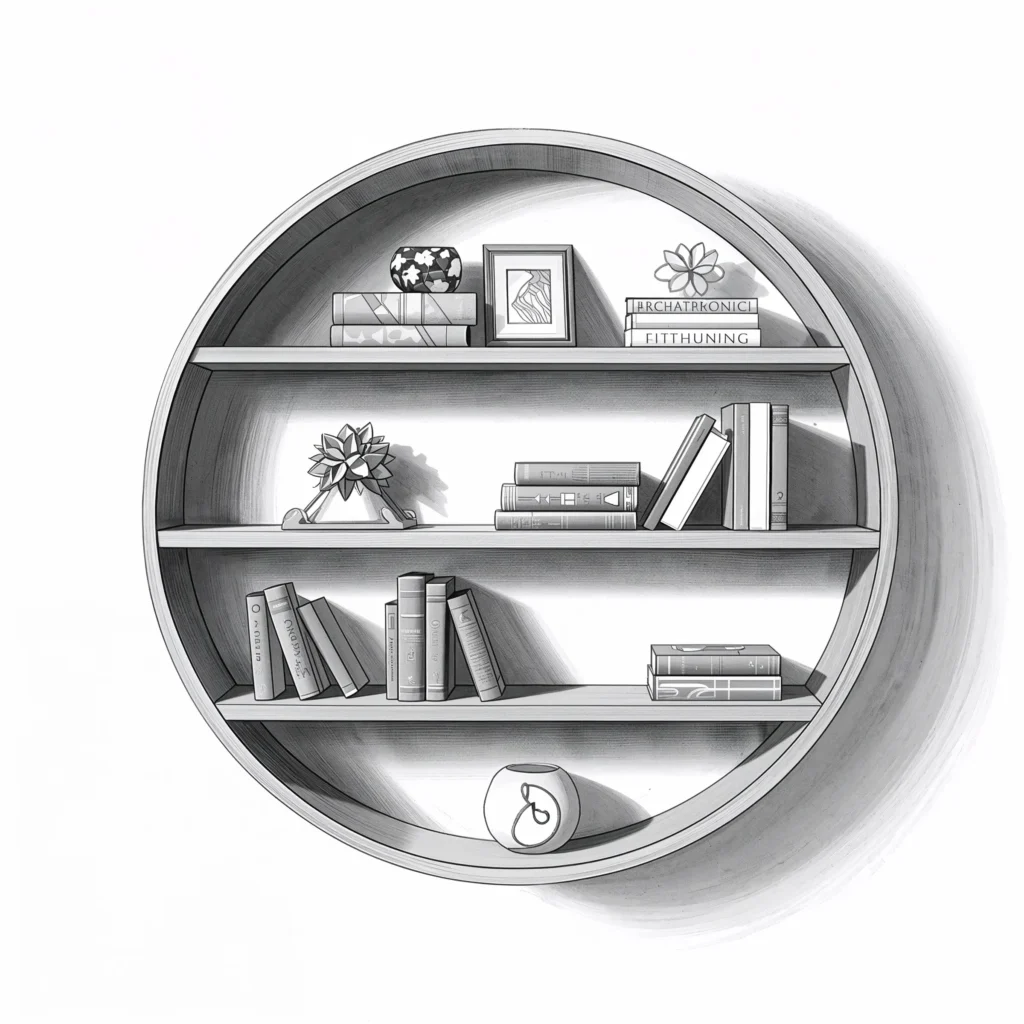
Round bookshelves are having a moment, and honestly? They deserve it. Drawing circles might seem basic, but creating a functional-looking circular bookshelf takes some planning.
I start with a perfect circle (compass or traced – no judgment here). Then I divide it like a pie, but here’s the kicker: the divisions don’t have to be equal. Mix it up! Some sections can be tall and narrow for paperbacks, others wide for those coffee table books we all pretend to read.
The magic happens when you add depth. Each section needs to look like it could actually hold books. I draw the back panel slightly smaller than the front opening, creating that 3D effect. Add some books at various angles – some standing, some leaning – and suddenly your circle comes alive.
Creating Visual Interest
To make your circular shelf drawing stand out:
- Vary the compartment sizes dramatically
- Include curved dividers alongside straight ones
- Add books that follow the curve
- Consider a double-circle design (circle within a circle)
Vintage Wooden Bookshelf
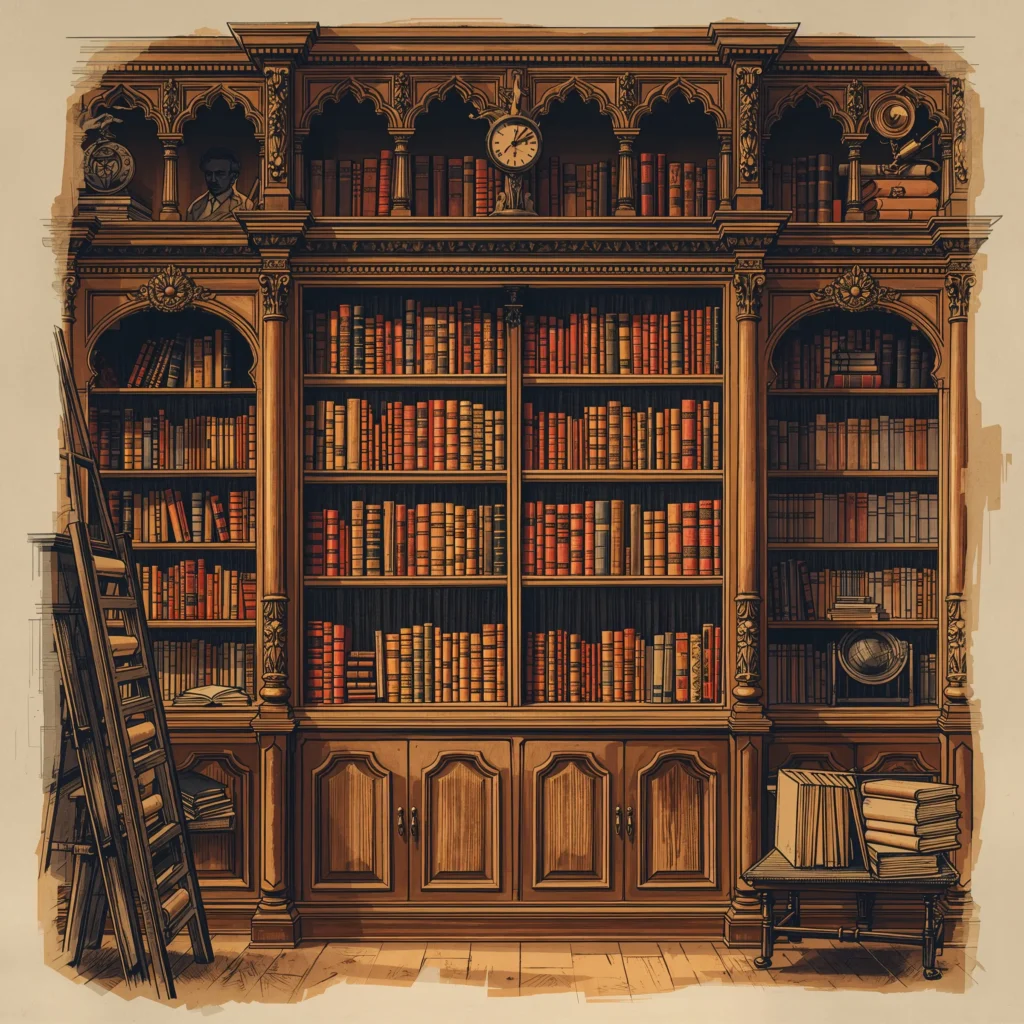
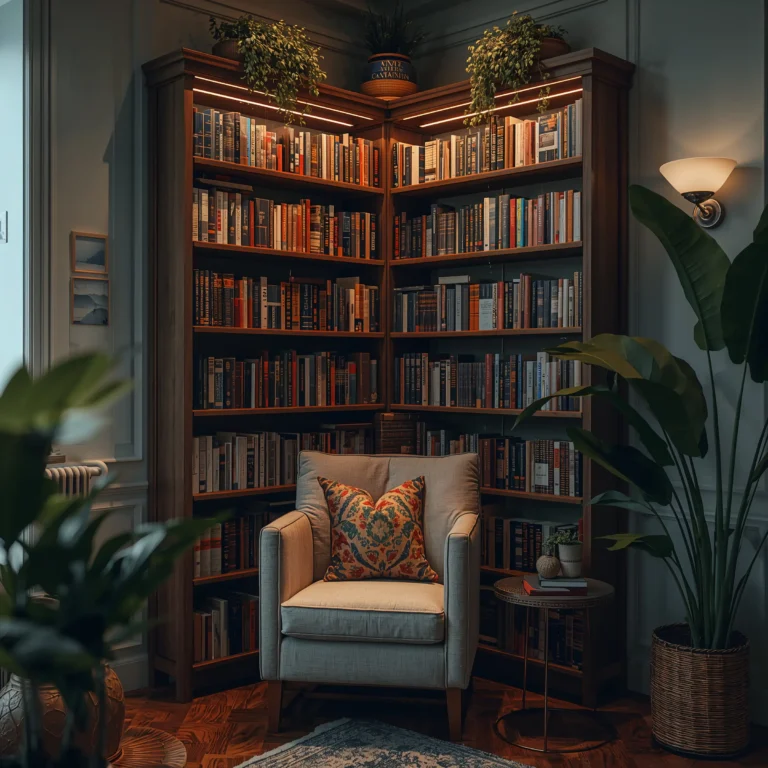
There’s something about vintage wooden bookshelves that just screams “cozy reading nook.” Drawing them is like capturing nostalgia on paper. I love adding all those little imperfections that make vintage pieces special.
Start with a basic rectangular frame, but here’s where it gets fun: add character! Maybe the top has decorative carved details. Perhaps the sides feature turned columns. Wood grain is your best friend here – those wavy lines instantly telegraph “vintage wood.”
Don’t forget the wear and tear. A scratch here, a slightly warped shelf there. These imperfections tell a story. My favorite vintage bookshelf drawing has a wobbly middle shelf that I imagine barely holding up after decades of heavy encyclopedias.
Vintage Details That Matter
Key elements to include:
- Ornate crown molding at the top
- Visible wood grain patterns
- Brass or bronze hardware details
- Slightly uneven shelves (for that authentic look)
- Maybe a mysterious carved inscription
Also Read: 10 Stylish Bookshelf Organization Ideas for Small Rooms
Hanging Rope Bookshelf
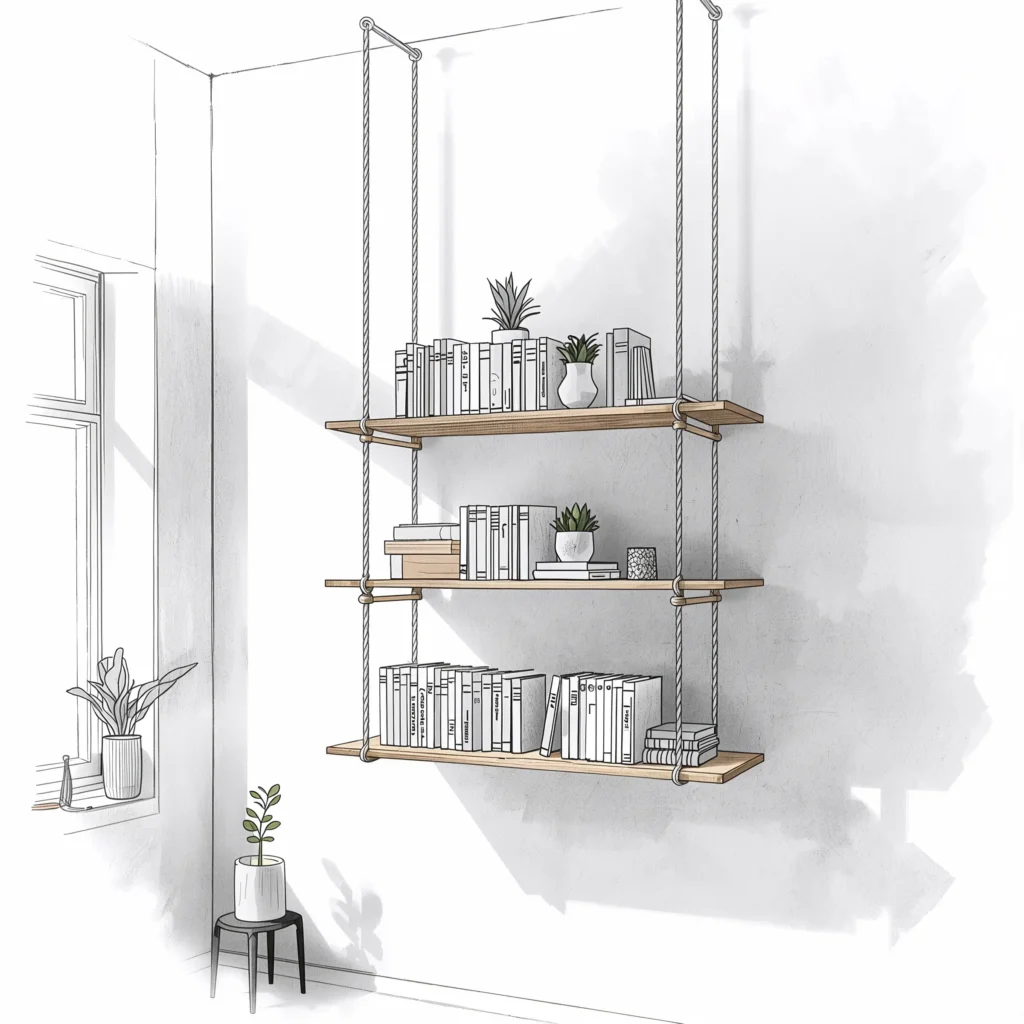
Now here’s a design that makes people do a double-take. Hanging rope bookshelves combine rustic charm with modern minimalism, and they’re surprisingly fun to draw.
Picture this: wooden planks suspended by thick rope, creating floating shelves with personality. I start by drawing the planks first – usually three or four at different heights. Then comes the rope. The trick is making it look like it’s actually supporting weight. The rope should have a slight curve, not be perfectly straight.
Shading is crucial here. The undersides of the planks need deeper shadows, and the rope should cast subtle shadows on the wall. I like to add texture to both the rope (twisted fibers) and wood (grain patterns). It’s these details that sell the whole nautical-meets-library vibe.
Rope and Wood Texturing Tips
For realistic texture:
- Draw individual rope strands at connection points
- Show wood grain running horizontally on planks
- Add knots in the rope for authenticity
- Include metal brackets or loops where rope attaches
Bookshelf with Built-In Ladder
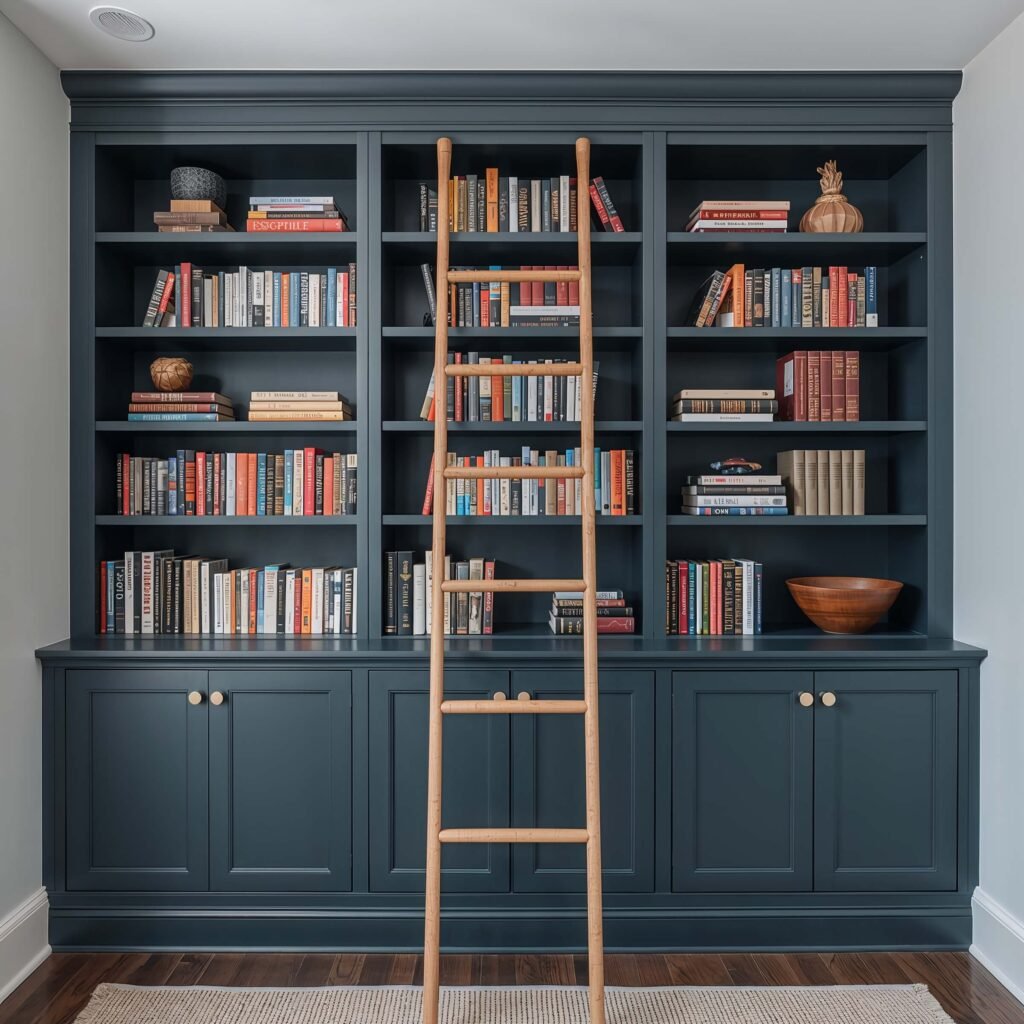
Remember those gorgeous library scenes in movies where someone glides along on a rolling ladder? That’s what we’re drawing here, folks! This design combines the bookshelf with its own access system, and it looks absolutely epic on paper.
I approach this as two drawings in one: the bookshelf and the ladder. The shelf should be tall – we’re talking floor-to-ceiling ambition here. Draw it with multiple sections, maybe 6-8 shelves high. The ladder can be on a rail system (those parallel lines at top and bottom) or just leaning casually.
What sells this drawing? The interaction between ladder and shelves. Show someone climbing it, or books being placed on a high shelf. Maybe the ladder’s at an angle, suggesting recent use. These human touches bring your drawing to life.
Making the Ladder Look Functional
Important ladder details:
- Rails or tracks at top and bottom
- Proper proportions (rungs about 12 inches apart)
- Wheels or sliders visible
- Safety features like hand rails
IMO, adding a small figure using the ladder makes the whole drawing more engaging 🙂
Spiral Bookshelf Tower
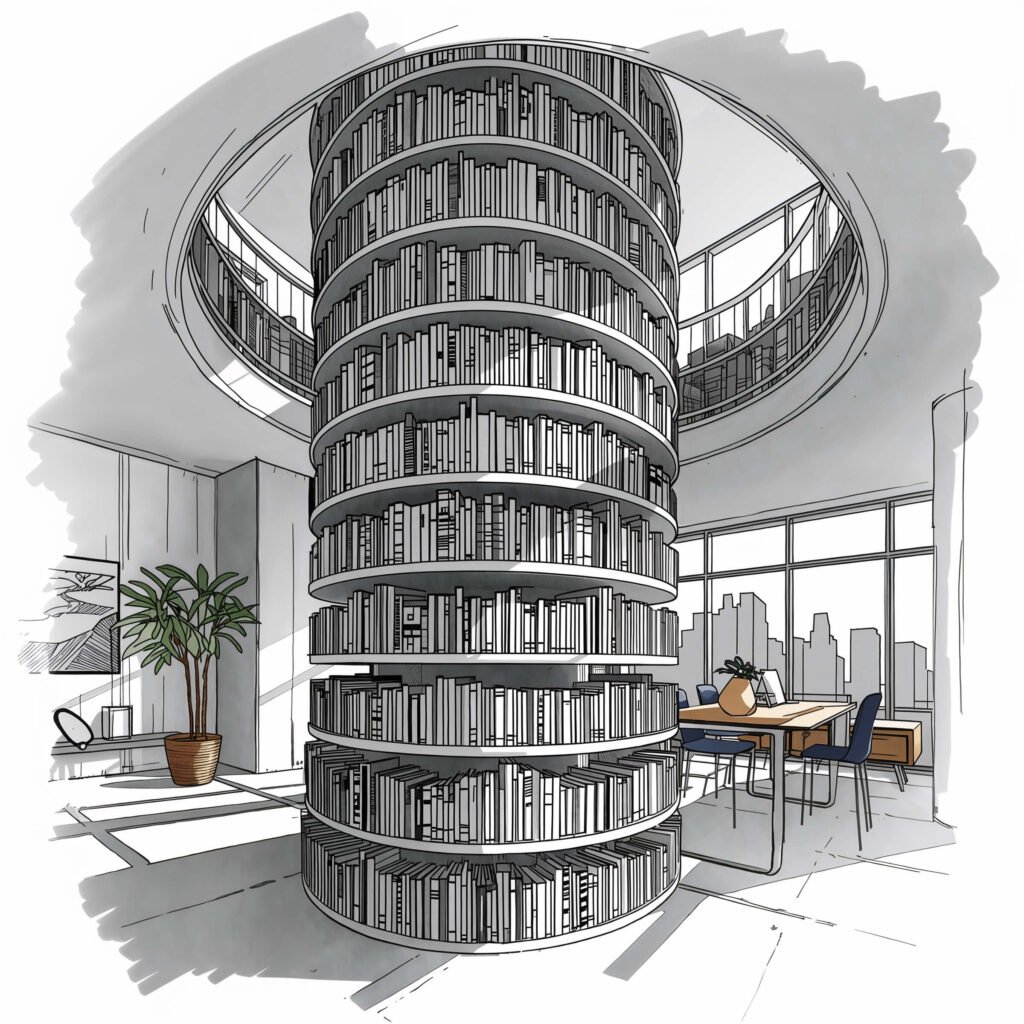
Get ready for the showstopper! Spiral bookshelf towers are architectural candy – they look impossible but totally captivating. Drawing one is like solving a really satisfying puzzle.
Start with a central column. Now, imagine a spiral staircase, but instead of steps, you have shelves. Each shelf rotates slightly from the one below it. I usually draw guidelines first – a cylinder for the core and spiral lines showing where each shelf attaches.
The perspective here can be tricky. Shelves at the back appear narrower, while front shelves show their full width. I spend extra time on the books, making sure they follow the curve of each shelf. Some face out, some spine-out, creating visual rhythm as your eye travels up the spiral.
Mastering the Spiral Perspective
Key techniques for spiral success:
- Draw a central axis line first
- Keep shelf spacing consistent
- Show books following the curve
- Add shadows that emphasize the spiral motion
- Include a few books mid-placement for dynamism
Also Read: 10 Creative Nursery Bookshelf Ideas to Transform Your Baby’s Room
Modular Cube Bookshelf
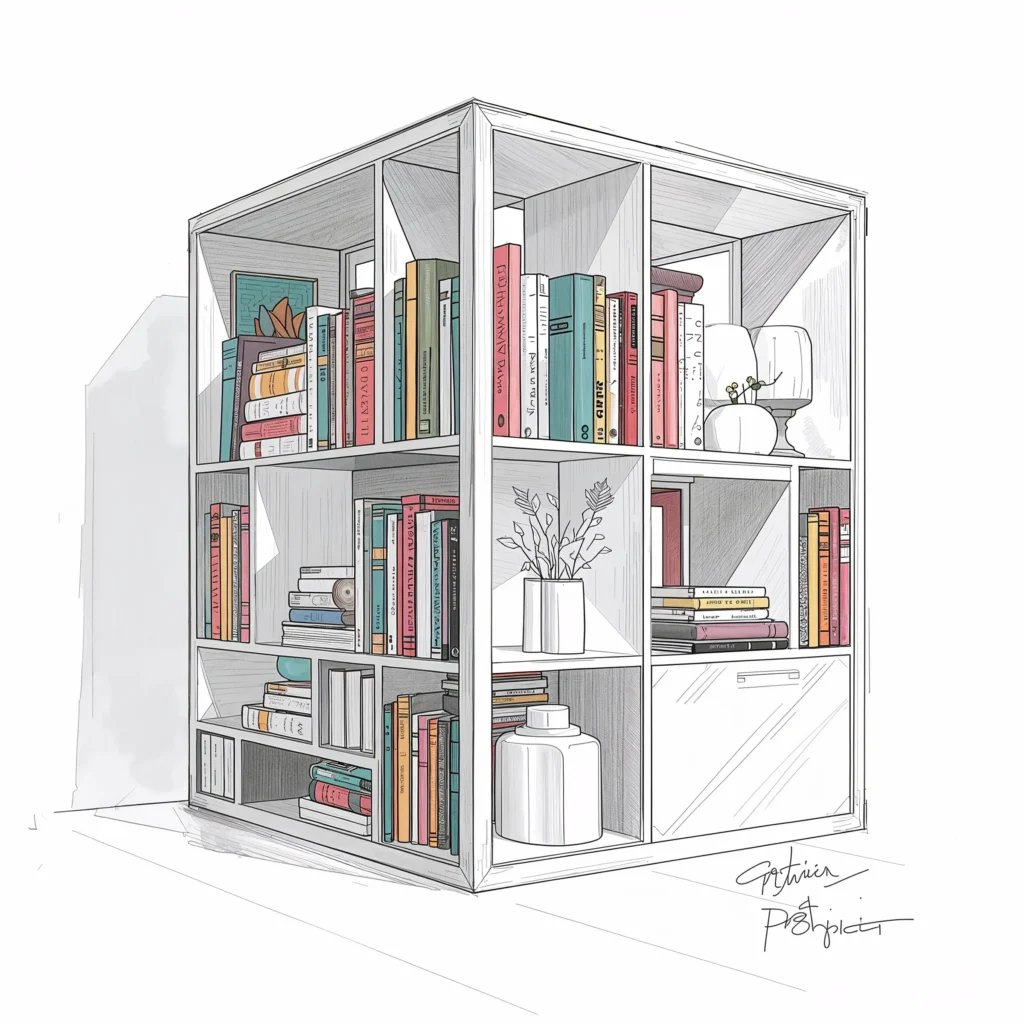
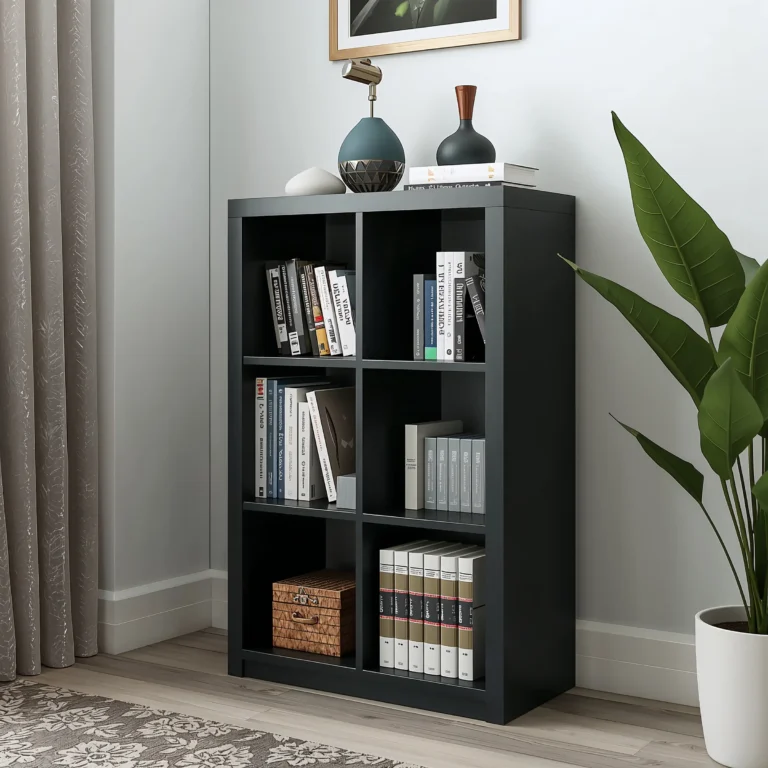
Last but definitely not least, we have the modular cube bookshelf. Think adult LEGO blocks that happen to hold books. The beauty here is infinite customization – stack ’em, spread ’em, arrange them however your heart desires.
I love drawing these because you can start simple and build complexity. Begin with one cube. Now add another. Stack some, leave gaps between others. The negative space is just as important as the cubes themselves. It creates visual breathing room and prevents your drawing from looking like a storage unit.
Each cube can tell its own story. One might be packed with books, another holds a plant, a third displays a sculpture. This variety keeps the eye moving and makes your drawing more interesting than just rows of books.
Arrangement Ideas That Pop
Creative cube configurations:
- Pyramid or stepped formations
- Checkerboard pattern (alternating filled/empty)
- Random scatter that somehow balances
- Color-coding (even in pencil, through shading)
- Mixed orientations (some diamonds, some squares)
Bringing Your Bookshelf Drawings to Life
So there you have it – 10 bookshelf designs that’ll keep your sketchbook busy for weeks. The real secret to great bookshelf drawings isn’t perfect lines or advanced techniques. It’s about capturing the feeling of a space where stories live.
Whether you’re sketching that minimalist floating shelf or tackling the complex spiral tower, remember that every bookshelf tells two stories: one about the books it holds, and another about the person who arranged them. Your drawings should capture both.
Next time you’re stuck for drawing inspiration, grab a pencil and try one of these designs. Start simple if you’re feeling rusty. That minimalist floating shelf is calling your name! Or go big with the spiral tower if you’re feeling ambitious. Either way, you’re creating something unique.
Want to know the best part about drawing bookshelves? You can design impossible things that physics wouldn’t allow in real life. Make that tree bookshelf grow through the ceiling. Let that spiral tower twist into infinity. Your sketchbook, your rules.
Who knows? Today’s sketch might become tomorrow’s DIY project. Or it might just stay in your sketchbook, a perfect little world where every book has its place and every shelf tells a story. Either way, you’re creating something special. So grab those pencils and show those bookshelves who’s boss!